Thursday, July 30, 2015

Translation prompt--great classroom idea

During one of our sessions, Cat gave us  "translation prompt." Basically, she gave us several poems that were written in other languages. Based on the appearance of the words, as well as syllabication patterns, the idea is to write an English "translation." The activity was incredibly challenging for me, but I think it would work well for students. I kept trying to match up words closely and was getting frustrated. I think students would, however, be very open to this kind of writing activity.

These are some of the poems that Cat gave us.


I attempted to "translate" the top poem and came up with these lines:

Asking for happiness
May be dangerous
Now, giving of amulets   (that's the line where I gave up b/c my poem turned wacko)

I tried translating the same poem a second time and had a little more success.

Asking for happiness
is my daring act.
I'm not going to understand
your death or missing you.
Now that I've imagined living,
I ache to persuade you.   (Still not the most solid piece of work, but again, prompts are not meant to act as the "be all, end all." Prompts are just another way to get "into" a poem and begin building one). 

Day 3, 7/15/15, afternoon session

At the end of our morning session, and a bit into our afternoon session, we had some time to write. We were supposed to take one or more of the lines from the fruit/vegetable exercise and incorporate them into a poem.

My mind was completely blank and, much like most of us do when we feel blank-minded, I turned to my phone for some respite. I noticed a fascinating Facebook post that featured an article from the website, mentalfloss. The article was (phenomenally) titled "Making Out Isn't As Popular As You Think It Is." It basically detailed romantic/sexual kisses in Western culture vs other cultures. 

This particular paragraph caught my interest:


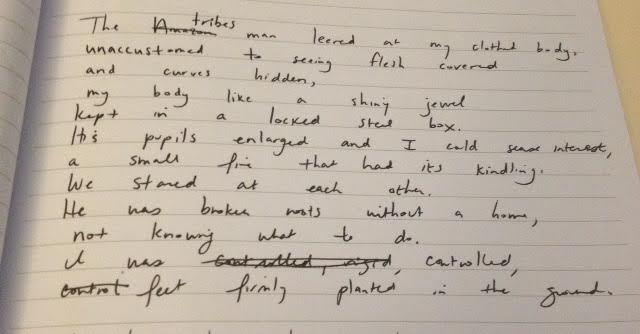
From that paragraph, my "writer's block" became cured. I started writing a poem about a tribesman who comes to the U.S. and is unaccustomed to seeing women who cover their bodies.  The other person in the poem is a woman who is used to the "game" of dating--- being wined, dined, and having "requisite kisses" at evening's end. I ended the poem by having the woman kiss the tribesman, whereupon he screams. 

I was able to incorporate Melissa's line of "broken roots without a home" into my piece.

The poem is still very much a work under construction, but this is the first stanza: 

We spent a large portion of the afternoon listening and critiquing each other's pieces. We read/listened to Svea's "Since You Asked," a poem written after we had read Billy Collins' "Litany." Frankly, I liked Svea's poem better than Collins'. We also listened to one of John's poems and a poem by Melissa. Although I knew it was a very rough draft, I shared my poem about the tribesman. 

One of the comments I received was that the readers did not know exactly where the poem was taking place. In my mind, I perceived the tribesman as being in the U.S. For revision, I have to make the setting clearer. Honestly, I wanted to turn the piece into something quite ridiculous. I'm thinking that the setting might be in a mall food court. Another comment I got was connected to my usage of the line "pillage, penetrate, and leave" in relation to the tribesman's experiences in life.  I knew those were not the best words when I wrote the piece. They're loaded words that bring have a definite negative, horrific connotation with them. The tribesman poem is nowhere near being completed, but I welcomed the valuable feedback that I received and will definitely be revising the poem in the future. 

Prompts-- I love 'em and hate 'em

Okay---so this is supposed to be a reflection from day one, but it ended up a bit out of order. Anyway.....

Writing prompts work well because one can never utter, "I don't know what to write about." Prompts give guidance, like an adult holding a child's hand while walking across the street.

I immediately knew that prompts two and three did not appeal to me, which often also means "too challenging." If I really forced myself, I know that I could have written to one of those prompts and probably written something decent (if you can do something "decent" for a first draft, you've gotten a good start).

I chose to use Edwin Brock's poem as a springboard for my own.

Brock's poem---


My poem: "Five Ways of Irritating the Neighbors" (draft one)


Day 3, 7/15/15, morning session

On this morning, we looked at two poems: "Talking to an Identical" by Taylor Mali and an excerpt from Wallace Stevens' "Someone Puts a Pineapple Together." We also came into class and were greeted by this colorful scene.

Stevens' poem describes a pineapple with such lines as "...It has a hundred eyes" and "The sea is sprouting upward out of rocks." Cat told us to look at and touch the various fruits and vegetables on table. We then were to create short snippets. The idea is to just get the mind thinking in different directions and to come up with metaphors/phrasings that normally might not "just appear" in one's mind. Some of the phrases might end up in a poem and some of them might end up being nothing, but the exercise pushes your mind.


Here were some of my musings:

coconut- stubble on a man's face that I touch and soothe after a long day of labor

ginger- misshaped fingers of a man in a freakshow

carrot- spear that I brandish in the air as I conquer the world

dragonfruit- used sheets of sandpaper laying across a worktable, waiting to be used again

eggplant- body of a fertility goddess

We later went around the table and everyone read from their lists. We were supposed to take note of lines that appealed to us, for use in a later poem. I took note of "fat man's thumb" and "broken roots without home."

During the morning, we also listened to/critiqued ("green roomed") Mary's poem, "Hansel and Gretel." Cat talked about nonceforms; this is basically when a poet uses a new form/pattern one time for a particular poem. A more elaborate definition can be found here: 

Wednesday, July 15, 2015

day 2, 7/14, afternoon session

The afternoon session is tough to get through. I blame this on the delicious, but carbohydrate-laden Panera lunches.

In the afternoon, we read Charles Bukowski's "Ask," as well as a poem written in chronological format. We critiqued Mary's cat poem (a poem written from the viewpoint of her cat, Tony) and Svea's autobiography/chapters poem. We also read Galway Kinnell's "Hide and Seek" and were given the option of writing in response to Kinnell's poem.  As a group, we brainstormed various traditional children's games too.

Here's Kinnell's poem.


Here's my first draft. I'm sure that Galway Kinnell would appreciate that his poem inspired me to write a poem about Seven Minutes in Heaven (which also features an introductory stanza with Jordan Knight from NKOTB).


John's poem and what I love about aTi

What I love about aTi is that there's such a wide range of people and talents. Our group is interesting in that each person has his/her own writing style and while all of our poems are very different, they are all spectacular. I realize that sounds a bit hokey to say, but I feel that it's true.

We also did the "green room" critique of John's poem on day two. John's poetry is so incredibly different than mine. Even if I aspired to write like someone else in the group, it wouldn't be able to happen. We all bring different experiences (both writing experiences and life experiences) to the proverbial table. We can, however, fully appreciate each individual's skills as a writer.

This is John's poem:


While I was clueless as to how to use the line "Ok, partner, this is it," John easily (or so it seems) weaved the word into the beginning of his poem. He also used the Sappho quote too. I love the eerieness of the poem (graveyard behind the casino) and the little details (purple chair) that really make the piece.

Sometimes we say, "I wish I had written that!" In reality, we need to be the best writers that we can be while also appreciating the gifts and uniqueness of others.

Day 2, 7/14, morning sessions

We started out the morning by reading several poems: "Gone Ladies" by Christopher Logue, "Naming My Daughter" by Patricia Fargnoli, "Litany" by Billy Collins, and "Self-Portrait" by Sue Standing. While all four poems were vastly different, we agreed that they all featured their own types of repetition. Additionally, each poem featured the theme of identity.

Our goal for the morning was to use of one of those poems as a springboard for a poem of our own. Another option was that we could write our own autobiography by using 10 chapter titles and descriptions. The group dynamic is interesting. Some of us are the A+ students who take Cat's directions and follow them to heart. I guess I am the C student; I take the prompt directions, but sometimes deviate from them. I figure that the point of the aTi sessions is to develop our craft by whatever means possible. Sometimes the prompts work for me, but when they don't, I depart from them.

Shown below are my two drafts. The first draft really shows what happens when someone writes. Words get crossed out, then added back in, and then crossed out (case in point: my line about "You don't worry..." --- I was quite undecided between the words cancer, pain, time, and death). In the last stanza, I changed the word "concern" to "remorse," being that remorse is definitely a stronger, more calculated emotion. One of my stanzas is also boxed-- a signal to me to move it later in the poem.


Shown below is draft #2, typed. There are small changes, but they are there (I changed "because you will use all of it" to "because nothing will go waste." I'm looking forward to sharing this with the group and getting more feedback.


The remainder of the morning was spent critiquing John's poem and my poem ("Five Ways to Irritate My Neighbors"). In terms of feedback, the group said that the poem features so many colors, but when I describe the wrought-iron animals, I just say that they are "colorful." Instead, I should go back and decide on color words to use. This is a small editing suggestion, but one that will definitely add to the piece. The line "mosaic of imbibed enjoyment" was abstract (which I definitely kind of felt anyway), so I'm going to get rid of it. Another line, "in contrast with theirs," is not really necessary to say, so I'm going to get rid of that too. The thing with poetry is that, especially with smaller pieces, there are not necessarily gigantic revisions, but the revisions that occur do make all of the difference.

Tuesday, July 14, 2015

"The Green Room," critiquing Cat Doty style

During the afternoon, we had another prompt to attempt. We had to write how-to directions for a task or give instructions on how something happens.

As a writer, I struggle with finding my voice. While I appreciate descriptive writing, whenever I attempt it, it feels forced. I'm rarely satisfied with the results either. I consider myself a sarcastic individual, but I can rarely get humor into my writing.

This is the draft that I came up with (this is actually the second draft, although the changes between the first and second draft are minimal). I actually think it captures my voice pretty well:)


During the afternoon session, Cat had us do the "green room" critique technique. This consists of having the poet's work read twice (generally once by the poet and then by someone else). Then, for 15 minutes, the poet is in the imaginary "green room." The rest of the group discusses the poem (likes/dislikes for lack of better words, questions/confusions, suggestions for revision). After 15 minutes, the poet is allowed out of the "green room" and can converse with the rest of the group.

I find the "green room" technique to be helpful. It's interesting to listen to your readers discuss your poem and not be able to immediately jump in and say, "Oh, what I meant is..."

I really liked what I shared with the group because I thought it showed my personality. Sometimes, when I'm writing in a group, I feel censored. I didn't feel censored or uncomfortable at all, which says a lot about our group dynamic on day #1.

Day 1, 7/13/15

This is my fourth year at aTi and my third year of completing the poetry sessions. This year, the session is once again being led by Cat Doty. I took aTi sessions with Cat last year too. I appreciated the open environment that she created.

Our group consists of six people: Svea (I met her last year--she is a high school teacher), Mary (another high school teacher and also Svea's colleague), John (an intriguing poet who owns a Staten Island house that is also a historical landmark), Mary (a music teacher who also has known John since 2004), and Melissa (a third grade teacher). Most of us have previous experience with writing, but Melissa is new to the genre of poetry. What I like most about aTi is that the organization encourages people to break free from their general disciplines. While many of the aTi participants are either art or writing teachers, it is always fascinating to have people who teach other disciplines/grade levels too.

We started off the morning by reading several poems that Cat gave us. Some of the poems were ones many of us knew well ("Did I Miss Anything?") and others were completely new to some or all of us.

One of the topics of discussion that came up was titles. I know that when I was younger, I used to put little effort into my poems' titles. The titles would generally be short, 1-2 word phrases. I could easily see myself having poems with titles like "Cornfield," "Broken Heart," or "Loneliness." We discussed how the poem could easily get the poem started and could basically get it "running." For instance, in Tom Wayman's poem, he could have started the first few lines by describing a scenario of a student asking if he/she missed anything from the previous class. Instead, Wayman titles the poem "Did I Miss Anything?" and then begins the poem with the first response: "Nothing..."

A title seems like a small thing, but when you think about it, titles are extremely important. People judge books by covers, but they equally judge books (and poems too) by titles.

We also spent a substantial amount of time on two list-style poems, "In the Basket Marty Brought to the Hospital After the Cesarean" by Thorpe Moeckel and "What's In My Journal," by William Stafford. While both poems were similar in that they were written in list form, we spoke about the differences between the two. The Stafford poem left me, as a reader, thinking. There were lines that confused me and were, dare I say, enigmatic. The Moeckel poem simply irritated me. I've concluded that a headache after reading a poem is one of two things: 1] completely negative because the poem has annoyed you or 2] completely positive, although frustrating, because the poem has gotten you to think.

At the end of the morning, Cat sent us off with a few prompts. We could use Edwin Brock's "Five Ways to Kill a Man" as a springboard for a "Five Ways..." poem of our own. We could incorporate the line "Okay, partner, this is it" into a poem. We could also attempt to use a fragment from Sappho in one of our pieces: "I would not think to touch the sky with two arms."

Off we went to write...

Wednesday, August 13, 2014

Day 5, Afternoon presentations and goodbyes

During the afternoon, the aTi participants were able to see the final products completed in the various workshops. Printmaking impresses me because although the final pieces look "easy," I know that the artists have to print layer upon layer; it's a time-consuming process. Songwriting/music tech impresses me since it's like writing poetry, but going one step further by adding instrumentation. The participants in book arts always have to exhibit patience throughout their entire work process. Seeing what the pottery participants create interests me since I took the aTi workshop with Deb Goletz last summer. Overall though, I'm always most impressed by the oil painting workshop attendees. They seem to produce so many paintings within the five days---it's impressive. I also enjoy seeing the various subject matters that they paint. Similar to poetry, seeing artists' paintings gives you a look into their lives.

Below are some of my favorite paintings.


Artwork by Denise... 
Lisa's artwork
Once the time came for the aTi poets, we individually read two of our poems. We didn't have microphones, so I was worried about how well my voice would project. Then again, I am a middle school teacher----projecting a loud voice is something at which I am skilled.

I chose to read "Outside World" (my Paraclausithyron piece) and my cocoa butter poem. I tried to look up at the audience while reading the poem, but I was nervous too. At one point though, looking up at the audience just seemed to be the right thing to do....because then my poems were not just stand-alone pieces with which I could connect and engage...others were then brought into the poem too. 

The end of aTi reminds me of the end of summer camp. I was excited to go home, see family and friends, and get back into regular "routines." Even though I did not participate in the "residential" aTi experience this year, these aTi workshops are consuming. I called my workshop "poetry boot camp." We'd be at our sessions from 9-5; then, once we got home, we'd continue working on drafting and revising.


On the last day of aTi, I begin worrying, How will I make time for poetry ? The fact of the matter is that if something is one's passion, she will make time for it. I am reminded of a favorite quotation by H. Jackson Browne, Jr : “Don't say you don't have enough time. You have exactly the same number of hours per day that were given to Helen Keller, Pasteur, Michaelangelo, Mother Teresa, Leonardo da Vinci, Thomas Jefferson, and Albert Einstein.”

I'm hoping that this summer's aTi experience was simply the beginning of my creative journey for this year, but I'm already looking forward to aTi 2015. 


Day 5: Poetry workshop is filled with smiles and...tears.

Throughout the five days of aTi, our group shared drafts and revisions of writing pieces. Day five, however, truly showed me how you could have six writers in a room (Laurie, Seema, Svea, Susan, our faciliator Cat, and me) and have completely varied working methods, editing styles, and subject matter of pieces. Seema would always begin her drafts by hand writing them; Laurie did too. Svea had a journal that she filled for pages and pages with freewrites. She then would take those freewrites and draft them into poems. Susan handwrote, but she also typed on her Ipad. I would drift from hand writing pieces to typing them, but I'd always be listening to music on my headphones. We wrote many drafts and did several revisions during the week, but the following are some of the most memorable pieces (to me).

***Seema's ode to her loom
***Seema's poem about making noodle kugel for her husband
***Laurie's poem about Tinkerbell's divorce
***Laurie's poem about Meatball City
***Susan's poem about the various weights we carry in life
***Susan's poem about "the word"
***Svea's poem about the backyard of a house
***Svea's poem about yellow jackets, her sons, and an eerie dream

During these five days, we got to know each other well. When I last attended aTi for poetry (summer of 2012), there were moments when members of our poetry workshop cried. When most people write poetry, they're not writing about flowers, rainbows, and horses. They write about experiences, and many times those are experiences are painful. Last year when I attended aTi for pottery, I remember making the joke of "No one ever cries in pottery workshop."

Well, my tears appeared on this last day of aTi. Like I previously said, when it comes to sharing emotions, I tend to hold back. On day five, I shared an older piece with the group, a poem entitled "Presence." This poem is representative of the types of pieces that I would like to write all of the time. Poetry is challenging though; it takes a lot out of you.


Monday, August 4, 2014

Ekphrastic poetry

During our afternoon time with Renee, we completed an ekphrastic poetry prompt. Ekphrastic poetry is simply poetry which is inspired by a work of art. For this prompt, we rummaged through various prints that Renee provided. Some were religious images, some were realistic landscapes, and some were abstract images. I was intrigued by Gypsy Witch  by Joanna Ruocco.

We first described the image for 10 minutes. Then, we wrote down 3-5 questions that the art seems to be asking. We next wrote a zen parable about the artwork in which we answered at least one of the questions we posed during the last mini-activity. Lastly, (and oddly) we received a non-fiction article and had to pull out facts from it and write them down. The prompt was originally created by Kathy Grayber and, in short, these were the steps:

1. Describe the art only
2. Discuss issues raised by art
3. Tell a story from life
4. Use external information
5. Come back to the art

While I ultimately did not write a final poem from those various steps, completing those steps was an enriching experience. I might come back to that prompt at a later point and try it again, hoping to have its result be an ekphrastic poem.

Unfortunately, I could not find an online image of Ruocco's art, but here is what I completed for step one:


Day 4 with "the slasher"

On our fourth day of aTi, we had a special guest, poet Renee Ashley. On the previous day, Cat had shown us two poems by Renee.  One poem was early in Renee's career and was a straight narrative piece. The other poem was from a book entitled Her Book of Difficulty; the piece was significantly different from the narrative poem. It was interesting to see these two works because it gave us a scope of Renee's growth and evolution as a writer.

We started our morning session with a fun prompt that involved favorite film stars from childhood, favorite condiment or marital aid, favorite cuss word, and so on. This was just a goofy prompt to start the morning with, but during our later discussion, Renee stated that prompts are good for writers because they break us out of our patterns. As writers, we have an inkling of what our most proficient areas. Maybe it's dialogue or images or figurative language. After awhile, one can get in a writing rut and constantly write similar pieces. Prompts get us out of our comfort zones.

After we read aloud our pieces from the silly prompt, we each read a piece aloud and gave copies to everyone. Cat jokingly called Renee "the slasher," a term of odd endearment with which Renee also agreed. As we read our pieces aloud, Renee, armed with a red pen and green highlighter, made various marks on our poems. She helped us focus on unneccessary words and helped us try to break free from the structure of stanzas. In a small revelation, I looked at a rough draft of a piece and then compared it to my "final" draft. When I typed up the written poem, I compressed all of the stanzas together. However, when the poem was read aloud, the stanzas were still incredibly noticeable. There's nothing "wrong" with having stanzas, but it is important that us writers recognize our patterns. Sometimes patterns turn into crutches on which we rely too heavily.

I chose to read the following poem. I knew it was not a finished piece, but I was hoping to get some guidance on what to next do with the piece.


After I read the poem aloud, Renee asked me how I would critique myself. I was incredibly honest: "I like the images. The ending is cliched. The poem is really just observations and nothing else is really going on. I hate it."

We eventually got into a discussion on the craft of writing. Renee pinpointed the following as tenets of writing:
1. compression
2. image
3. seamlessness

She said that we can't just be "wonderful with words." There needs to be resonance. She also talked about how there should be tension in a poem, where one image has the reader focused, but then another image turns the reader around in a different direction. To show her point, she had us read Cat's poem, "Breathing Underwater." The poem begins innocently enough, with images of Weeki Watchee mermaids doing domestic tasks. The poem then veers into the image of holding one's breath and brings the reader to a dark childhood image. The poem makes the reader feel uncomfortable. After hearing the poem read aloud, I was, in fact, feeling breathless.

As a writer, I know that I have experiences underneath my surface which I can explore. My mother was an alcoholic. My father passed away when I was only 6 years old. Another father figure passed away when I was only 12 years old. I stayed with various friends and family members while my mother attended different rehabs. I just don't think I am ready to face those experiences and write about them. I think that's why I "latch" onto the images.

Like Renee said, there's more to writing than simply being "wonderful with words." Bravery is a component which I am still waiting to find.

Friday, August 1, 2014

Responding to Renee's prompt

During the writing time, my mind seemed blank. I was, however, "saved by the Internet."

I wasn't sure how to approach Renee's prompt. I tend to include narratives in my poems, but that was a no-no in her prompt. Time passed...nothing was on my paper. I'll admit it... I decided to roam the Internet for awhile. Since Sassy was the best magazine ever (it is no longer published), I frequently read the website, www.xojane.com. It's run by Jane Pratt, founding editor of Sassy magazine. I saw an article about homeless deterrents; these are basically spikes, sharpened stones, slanted walls, and other architechural designs that deter the homeless and other people from loitering. Horrible, right?

http://www.xojane.com/issues/anti-homeless-deterrent-spikes-hurt-homeless-people-and-they-arent-good-for-anyone-else-either

http://stsnext20.org/vignettes/2014/03/26/when-parisian-benches-have-politics-street-furniture-and-the-strategies-of-spatial-exclusion/

This is the poem that came about because of the prompt and the two articles:


In our afternoon session, I read "Deterrents" to the workshop group. When Cat has us read our pieces, immediately afterward, we enter a fake "green room." The writer remains silent while the others in the group discuss the poem. Cat created an open environment where we did not have to be "afraid" of having our poems discussed or critiqued.

The discussion about "Deterrents" made me smile. The group was discussing the images and how they were cold images, similar to images that would be in a dystopian piece. Questions were asked such as "Has the world ended?" One person in the workshop commented on the use of hydrangea bushes. Apparently, when iron (in the form of iron drops or even in the form of buried, rusted nails) is added to the soil of hydrangea bushes, it helps to make them have a blue hue. Someone had questioned where the mention of hydrangea bushes being near iron gates was intentional.

When I was "released" from the green room, I told the group about the article on homeless deterrents. In the end, it didn't matter if they thought my poem was about a Hunger Games-esque dystopia or if it was about my intended subject, homeless deterrents. The poem got the group to discuss and debate. Interestingly, even though I used tons of concrete images, without the narrative, the readers were left to figure out their own story to tell.

Day 3 prompts

I have a love/hate relationship with poetry prompts. There's the love aspect because of the challenge that they provide. Most workshop prompts are "out there" and very creative; if your mind is blank, a prompt forces you to have something about which to write. My hatred for prompts, or rather frustration, also stems from the challenge that prompts provide.

I am, however, fascinated with the various directions that writers take with the prompts. Even though everyone may be writing in response to the same prompt, there seems to be a limitless amount of ways in which writers will respond.

I definitely would like to incorporate some of these prompts with my students throughout the school year. Many students struggle with poetry writing because they think there is a certain "way" that a poem has to be written. They'll ask me questions such as "Do we have to use similes? Which point of view do we use? Can each line have capitals? Can there be sentences?" Prompts provide some kind of structure in which students can work (some students like that structure too), but then they also allow for plenty of freedom.

Overall, we received four prompts today. One prompt was to write something inspired by Ellen Bass' poem, "Remodeling the Bathroom." The poem surprises the reader by placing together the concept of one's last day of life with images of a bathroom renovation.

The next prompt involved creating several dream fragments that are also "wholly separate, independent narratives."

The third prompt was one from poet Renee Ashley. The prompt called for the writing of 10 lines with NO use of abstract nouns, a minimum of one concrete noun in each line, No narrative, and at least 3 sentence fragments.

The fourth prompt had the following guidelines:
1. Write about something in a room--it's moving---include it in the poem and keep it moving
2. Feature a seasonal piece of clothing in the poem
3. Include a recipe (brief description)
4. Include something Catholic


Day 3, morning critique

In the morning, we began by each reading a piece we had worked on during the previous day. I read a piece inspired by a Paraclausithyron prompt. In short, Paraclausithryon writings focus on the concept of being "locked out." The writer can take the concept of being locked out and approach it any way she pleases.

Below is the piece that I wrote:


The most helpful piece of feedback that I received is a gem of wisdom that all poets can use: do not slow down readers at the end of your piece by including ambiguity. My poem had an array of interesting images, but then I confused the reader with the lines "hundreds of people/ are hundreds of mirrors/ and if shards break away/ they can easily be replaced." While those lines might be interesting, they are definitely abstract and do confuse the reader. Throughout the poem, there is this tone of loneliness. Then, the mirror lines make it seem like the subject of the poem is judging others, or something along those lines. Those four lines completely alter the poem.

Many times, I think that us poets are hesitant to take out lines. Poetry is compressed as it is, and if we revise and take out lines, then our piece becomes, in some cases, significantly shorter. If those words detract from the overall piece, shouldn't they be cut out?

I think less experienced poets equate ambiguity with a poem being "deep." These aTi sessions have shown me that if you can make concrete images "deep," then that's when you're truly on your way to mastering poetry.